
When Ethics Must Be Louder Than Law - A Social Work Response to the Attacks on the Trans and Nonbinary Community: An Inspired Reflection by Chris McLaughlin, MSW, LCSW
Apr 19, 2026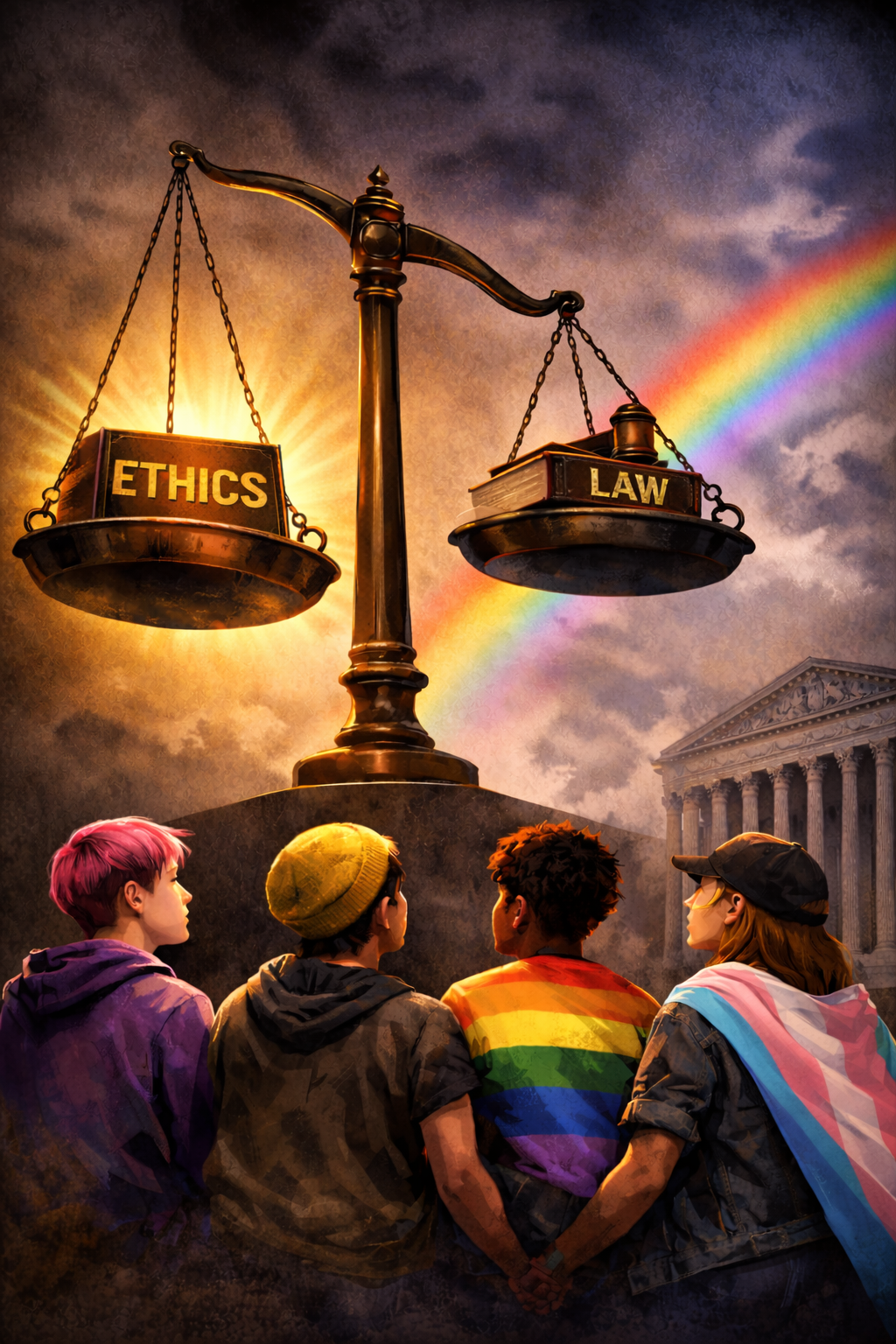
“[sexual orientation and gender identity] change efforts are harmful practices that are never appropriate with LGBTQI+ youth, and efforts are needed to end these practices.” – U.S. Department of Health and Human Services Substance Abuse and Mental Health Services Administration (SAMHSA), Moving Beyond Change Efforts: Evidence and Action to Support and Affirm LGBTQI+ Youth (2023)
As March turned to April, the Supreme Court of the United States (SCOTUS) issued a decision in Chiles v. Salazar that struck down Colorado’s ban on conversion therapy, a term used to encompass a wide range of efforts to change and person’s sexual orientation or gender identity. SCOTUS’s decision framed therapeutic conversations as “protected speech” rather than professional conduct. In doing so, the Court created a dangerous opening, one that risks legitimizing practices that decades of research, lived experience, and professional consensus have clearly identified as harmful.
So much for March going out like that proverbial gentle lamb…. This feels ALL lion energy to me.
Let’s be clear: So-called “conversion therapy” is not therapy. It is harm.
The Trevor Project’s 2022 study on the practice of “conversion therapy” identified more than 1300 conversion therapy practitioners across 48 states and the District of Columbia, a number that is likely a “significant underrepresentation of the true size and reach of the conversion therapy industry today.” Despite the many voices of a large number of professional medical and behavioral health associations across the country who, in unison, collectively condemn the practice of conversion therapy while also naming its ineffectiveness, it’s clear that conversion therapy is still happening to a large degree under the auspices of “help”, “support”, and “client-driven” care.
Despite the fact that there have long been regulations on what we as behavioral health and medical providers can and cannot say to our clients (AKA regulations on “free speech”), here we are…navigating a legal landscape where that harm is now more difficult to regulate.
Conversion therapy represents harm that has been documented across disciplines. Harm that shows up in increased rates of depression, anxiety, self-harm, and suicide among LGBTQIA+ youth. Harm that communicates, often explicitly, that a person’s identity is something to be corrected rather than affirmed. And harm that stands in direct opposition to the values that define ethical social work practice.
Trevor’s 2021 guide on the impacts of conversion therapy on LGBTQA+ youth is clear. Not only does conversion therapy create divisions between young people and their families (a dynamic consistent with family rejection), the opposite of family acceptance), but conversion therapy is associated with increased risks of depression, anxiety, and self-destructive behavior, including suicidal thoughts and attempts. In fact, Trevor’s 2024 U.S. National Survey on the Mental Health of LGBTQ+ Young People of more than 18,000 LGBTQ+ youth in our country found that LGBTQ+ young people who had been subjected to conversion therapy had more than twice the rate of attempting suicide in the past year compared to LGBTQ+ youth who did not report this experience. Close to 10% of the young people who responded to Trevor’s 2024 survey reported being subjected to conversion therapy in the United States. 64% of LGBTQ+ youth who self-reported a suicide attempt in the previous year shared that they were either threatened with conversion therapy or subjected to these practices in attempts to change their sexual orientation or gender identity. Just typing these statistics out (for not the first, nor the last I suspect, time) elicits an all-too-familiar rumble of rage within me. These data points do not come as a surprise to any elected official, local, state, or national. Trust me, every single LGBTQ+ advocate across the country have shared these findings with policy makers. And yet, these bills still pass. These decisions still are made. To be clear, the rage I feel isn’t about the mere passage of anti-LGBTQ+ legislation. It’s about the callous cruelty that sits at the center of these discussions. To intentionally enact such policies knowing the life-threatening consequences such decisions will have on already vulnerable young people is a level of inhumanity that is almost unfathomable.
A Response Falling Short
The National Association of Social Workers (NASW) responded quickly to SCOTUS’s ruling, expressing concern and reaffirming its opposition to conversion therapy. There is value in that. In their news release, “NASW Gravely Concerned by Supreme Court Decision on Conversion Therapy Ban”, NASW names their disappointment, references the evidence base, and calls social workers to act.
But if we are being honest with ourselves as a profession: the response from NASW did not go far enough.
Here, NASW… I took the liberty of rewriting the title of your news release for you: “Social Workers are Outraged and, Like, Really, REALLY Pissed Off by Supreme Court Decision on Conversion Therapy Ban”
I have to tell you, my friends. Today’s expressions of “concern” from organizational leadership feels a whole lot like yesterday’s “thoughts and prayers”.
In moments like this, language matters. And the language used in NASW’s response reflects a pattern that deserves our attention. Fortunately, I’ve learned a bit about discourse analysis this past year in my DSW Program with the University of New England.
The statement from NASW leans heavily on words like “concerned,” “disheartening,” and “disappointing.” While these communicate emotions, they stop short of naming the full weight of what is at stake. This is affective language without directive clarity, in other words, language that softens rather than sharpens the urgency of the moment. What is missing is the unequivocal truth: Social workers who engage in conversion therapy are violating the core ethical principles of our profession and causing harm to the very people they are entrusted to support.
This is not simply about differing approaches or clinical perspectives. This is about ethical breach.
What the Statement Reveals (and Avoids)
A closer look at the March 31st statement from NASW also reveals how power and responsibility are, or are not, named.
Throughout the response, the focus frequently centers on the organization itself:
- “NASW remains resolute…”
- “NASW has been a leader…”
- “NASW’s Legal Defense Fund…”
While this reinforces institutional credibility, it also shifts the narrative away from those most impacted. LGBTQIA+ youth are largely referenced through statistics rather than through lived experience, voice, or agency. The result is a statement that feels institution-centered rather than community-centered.
Additionally, the language often relies on passive constructions:
- “Conversion therapy is harmful and damaging”
- “Harmful practices threaten safety and well-being”
But who is doing the harm?
When harm is named without naming the actors responsible, accountability becomes diffused. This is particularly concerning within our own profession. The absence of explicit acknowledgment that social workers themselves can perpetuate this harm reflects a reluctance to fully turn the lens inward.
There is also a noticeable emphasis on legal framing by explaining the Court’s reasoning, outlining state-level implications, and preparing for legal uncertainty. While informative, this framing subtly reinforces the very hierarchy we should be challenging. It places the law at the center of the conversation, rather than clearly asserting that ethical standards must lead, regardless of legal ambiguity.
And perhaps most critically, the call to action focuses on individual responsibility (“practice with integrity”, “educate others”, “understand your state’s laws”) without naming mechanisms for accountability. There is no discussion of disciplinary action, reporting pathways, or the role of licensing boards in addressing unethical practice. This provides us with a response that leans toward professional encouragement rather than professional accountability.
Never Hesitate to Call the Foul
The National Association of Social Workers quite literally wrote the playbook for our profession. It is, without question, one of the most powerful tools we have to guide and shape ethical practice. The NASW Code of Ethics is embedded across every level of social work practice. The Code has been adopted by licensing boards in every state and territory, integrated into the accreditation standards of the Council on Social Work Education, and woven into the policies of agencies, organizations, and healthcare systems nationwide. In every sense, NASW sets the rules of the game.
So, here’s the question for leadership at the National Association of Social Workers: If you wrote the rulebook, why hesitate to call the foul?
In any game, the rules only matter if they are enforced. Now, anyone who knows me is likely to know that I’m probably the WORST person to be using a sports metaphor. It’s true, I’m no expert on anything that happens in the game of Sports Ball. BUT, here’s what I do know: When a player crosses the line, the referee doesn’t pause to reflect on tone or intent. They don’t issue a carefully worded statement from the sidelines to express their “concern” or “disappointment” in the actions of the players on the field, and they sure as hell don’t soften the call to avoid discomfort.
They blow the whistle.
Loudly. Immediately. Without hesitation.
They name the foul. They stop the play.
And they make it clear to everyone on the field and everyone watching from the stands that breaking the rules has consequences.
So, if NASW owns the rulebook for the field of social work, then this is their moment to really lean into that role.
Not as a commentator.
Not as an observer.
But as the official willing to enforce the very standards they established.
Because when the whistle is quiet, the message isn’t neutrality, it’s permission.
And in a moment where the harms are this clear, the profession doesn’t need a quieter voice. It needs a call that everyone can hear.
When Harm Is Named Clearly—And When It Is Not
Here in Maine, we are witnessing a parallel moment, one that further underscores the importance of language, clarity, and courage.
A proposed initiative (LD 2239) seeks to exclude transgender and nonbinary students from full participation in school activities and spaces. As of April ’26, the initiative to bring this question to Maine voters this November looks like it has the signatures it needs to be on ballot. Like the Supreme Court decision, this effort is often framed in language that sounds measured, reasonable, or even protective. It is presented as policy. As debate. As difference of opinion.
But let’s be just as clear here as we must be in our clinical spaces: This is harm.
It is harm that isolates young people from their peers.
It is harm that communicates that their identities are negotiable, conditional, or unwelcome.
It is harm that increases risk for mental health challenges, including depression, anxiety, and suicide.
And importantly, it is harm that is often disguised through language that avoids naming it directly.
This is where the contrast becomes important.
When institutions rely on language like “concern,” “disagreement,” or “complexity,” they can unintentionally create distance from the real, lived impact of these policies. We see this in national statements that stop short of naming accountability, and we see it in policy efforts that attempt to soften exclusion through carefully chosen words.
But here in Maine, we are also seeing something else.
We are seeing advocates, educators, families, and young people themselves speak with clarity and conviction. We are seeing people name, directly and without hesitation, that exclusion is not neutrality, it is harm plain and simple. That limiting access is not protection, it is discrimination. That silence, in moments like this, is not professionalism, it is complicity.
This is what ethical courage looks like in practice. It is not always comfortable. It is not always polished. But it is clear.
A Framework for Ethical Clarity
Moments like this call us back to the foundations of our ethical decision-making, not as abstract principles, but as lived practice. Navigating hard moments isn’t about having all the answers or avoiding hard conversations. This type of leadership is about having a process that centers people, values, and impact and moving through these moments deliberately and compassionately.
I developed the C.A.R.E.D. Framework for Ethical Decision Making as a practical, human-centered approach to navigating these moments with clarity and courage. In the C.A.R.E.D. Framework for Ethical Decision Making, we are reminded to:
- Consider the Context – recognizing the real-world impact of policies and practices on marginalized communities
- Analyze the Options – not only for legality, but for alignment with our ethical commitments
- Reflect on Values – grounding ourselves in dignity, worth, and justice
- Engage in Action – taking steps that actively reduce harm and promote well-being
- Debrief and Document – ensuring accountability and continued learning
When applied to both this Supreme Court decision and the proposed ballot measure here in Maine, the outcome is not ambiguous.
The context is clear. The harm is documented. The values are defined.
Which means, then, that the action must be clear, documented, and defined as well.
Naming Harm Is an Ethical Responsibility
If there is one lesson across these moments, national and local, it is this: We cannot afford to be vague about harm.
When harm is softened, it becomes easier to ignore, and when it is generalized, it becomes harder to challenge. This is where social work must lead, not just in what we believe, but in how we say it.
Not with hesitation or qualifiers but with clarity that reflects the seriousness of what is at stake.
This Is a Leadership Moment for Social Work
Legal decisions do not define ethical practice. Social workers do. WE do!
And this moment demands more from us than carefully worded statements or institutional balance. It demands clarity. It demands courage. It demands leadership.
Leadership that:
- Names harm without hesitation
- Centers the lived experiences of LGBTQIA+ youth and not just the profession’s position
- Acknowledges where harm can exist within our own ranks
- Calls for accountability, not just awareness
- Refuses to allow legal ambiguity to dilute ethical responsibility
Because here’s the reality: policies can shift, court rulings can change, but the impact of harmful practice on a young person’s life is immediate and lasting.
A Call to Courage (Not Just Action)
NASW called the recent SCOTUS ruling “disheartening.”
I would go further: it is dangerous.
And in dangerous moments, we cannot afford ambiguity. I believe that social work must be courageous in how we advocate externally and in how we hold ourselves accountable internally. Social workers must show courage in our clinical spaces by providing affirming, identity-honoring care. We need to be courageous in our organizations by challenging colleagues or systems that perpetuate harm and courageous in our profession by naming clearly that unethical practice has consequences. And perhaps most importantly, we must be courageous in how we as social workers show up for LGBTQIA+ youth by ensuring they experience social work not as another place of harm, but as a space of belonging, affirmation, and safety.
Final Thoughts
What we are witnessing here in Maine and across the country is not just a series of isolated events. These are tests of our profession’s willingness to lead with clarity. And as we move forward, the question is not what the law allows, but what our ethics demand.
The Trevor Project is clear. “Policy makers on all levels of government, state licensing boards, professional associations, accreditation agencies, the healthcare industry and related businesses, and faith communities must act expeditiously to implement the recommendations in this report and bring us closer to finally eradicating this destructive and ethical practice, creating a safer, more welcoming world where LGBTQ young people can not only survive but thrive as they are.”
SCOTUS’s recent decision may blur the legal lines, but it does not blur our ethical ones.
From Maine to the national stage, the message is the same: When harm is on the line, we don’t get to be vague. We get to be clear, we get to be loud, and we get to lead.
We know what affirming care looks like.
We know what harm looks like.
And as social workers, we have a responsibility to ensure that the line between the two is never left open to interpretation.
Now, let’s collectively get out there and play ball….
In community until next time,

Chris McLaughlin, MSW, LCSW
Owner & Lead Consultant
Inspired Consulting Group, LLC
Stay connected with news and updates!
Join our mailing list to receive the latest news and updates from our team.
Don't worry, your information will not be shared.
We hate SPAM. We will never sell your information, for any reason.
